Kindergarten students practiced
their cutting, gluing and painting skills while learning about Japanese artist
Yayoi Kusama, who is known for covering everything she paints, with dots. Students learned how to draw through observation. They looked at a real pumpkin and drew what they saw. Then they painted their pumpkin with dots, practicing good craftsmanship.
Thursday, November 12, 2015
Seascapes
First
Grade students looked at artwork by Winslow Homer. Like many artists, he
painted what was around him. He lived near the ocean so he painted many
seascapes. Students drew and painted their own seascape that includes a horizon
line and a sailboat.
Textured Chameleons
Kindergarten students learned
that we use the word texture when we’re describing how something feels.
Students created texture rubbings with texture plates. Students saw a video
clip of a chameleon changing color, and read A Color of His Own by Leo
Lionni. Then they traced chameleons, cut them out and glued them to the habitat
they painted for their chameleon.
Los
estudiantes de kinder aprendieron que usamos la palabra textura cuando
describimos como se siente la superficie de algún objeto. Los estudiantes
crearon calcos de texturas usando láminas texturizadas. Los estudiantes vieron
un video-clip de un camaleón cambiando de color, y leyeron Su Propio Color por Leo Lionni. Luego ellos crearon camaleones
siguiendo las instrucciones para un dibujo dirigido. Finalmente, ellos
recortaron sus camaleones y los pegaron sobre un hábitat que pintaron para su
camaleón.
Monday, October 12, 2015
Collaborative Neighborhood
Second
grade students compared characteristics of rural, suburban and urban
landscapes. They discovered that Kalamazoo
has all three of these areas. Urban areas have museums, tall buildings, and not
many houses. Students decided that the area around Bronson Park
and the Kalamazoo Mall could be considered urban. They discovered that suburban
areas have many houses, parks and schools. They decided the area around El Sol
could be considered suburban. They learned that rural areas have a lot of farms
and barns. They discovered that Kalamazoo
even has areas like this! If you get on the highway and drive for only 10
minutes, you will see farmland and barns.
Los estudiantes de segundo grado compararon
características de paisajes rurales, urbanos, y suburbanos. Descubrieron que
Kalamazoo tiene áreas de los tres tipos. Las áreas urbanas tienen museos,
edificios altos, y no muchas casas. Los estudiantes decidieron que el área
alrededor de Bronson Park y el Kalamazoo Mall se puede considerar urbana. Ellos
descubrieron que las áreas suburbanas tienen muchas casas, parques y escuelas.
Decidieron que el área alrededor de El Sol se puede considerar suburbana.
Aprendieron que las áreas rurales tienen muchas granjas y graneros.
¡Descubrieron que Kalamazoo también tiene áreas así! ¡Si viaja por la autopista
por solo 10 minutos, verá cultivos y graneros!
Wednesday, October 7, 2015
Creative Transformations
5th grade students
learned that graphic designers and graphic artists are artists who make people
see everyday items in a new way. They looked at Andy Warhol’s Campbell ’s soup cans and discussed how
changing the colors on the soup can labels could make people really notice the
soup and want to buy it. Students also discovered that there are artists who
create new fonts to use on the computer. They chose one letter of the alphabet
and transformed that letter to look new and interesting. They used common
“systems” that graphic artists use to help them come up with new ways to look
at their chosen letter of the alphabet.
Los
estudiantes de quinto grado aprendieron que los diseñadores gráficos y artistas
gráficos son artistas que hacen que las personas vean objetos cotidianos de una
nueva manera. Ellos miraron las latas de sopa Cambell’s de Andy Warhol y
hablaron sobre como cambiar el color de las etiquetas sobre las latas podría
hacer que las personas realmente se fijaran en esta sopa y la quisieran
comprar. Los estudiantes también descubrieron que hay artistas que crean nuevas
tipografías para usar en la computadora. Ellos escogieron una letra del
alfabeto y la transformaron para que luciera nueva e interesante. Usaron
“sistemas” comunes que usan los artistas gráficos para ayudarlos a pensar en
nuevas maneras de mirar la letra que escogieron.
Birch Trees
Students
in 3rd grade created birch trees using a non-traditional technique. They used
cardboard dipped in paint to create these birch trees. They arranged them on
their painted background in a way that shows foreground, middle ground and background.
Objects in the foreground appear larger and more detailed. Objects in the
background appear smaller and less detailed.
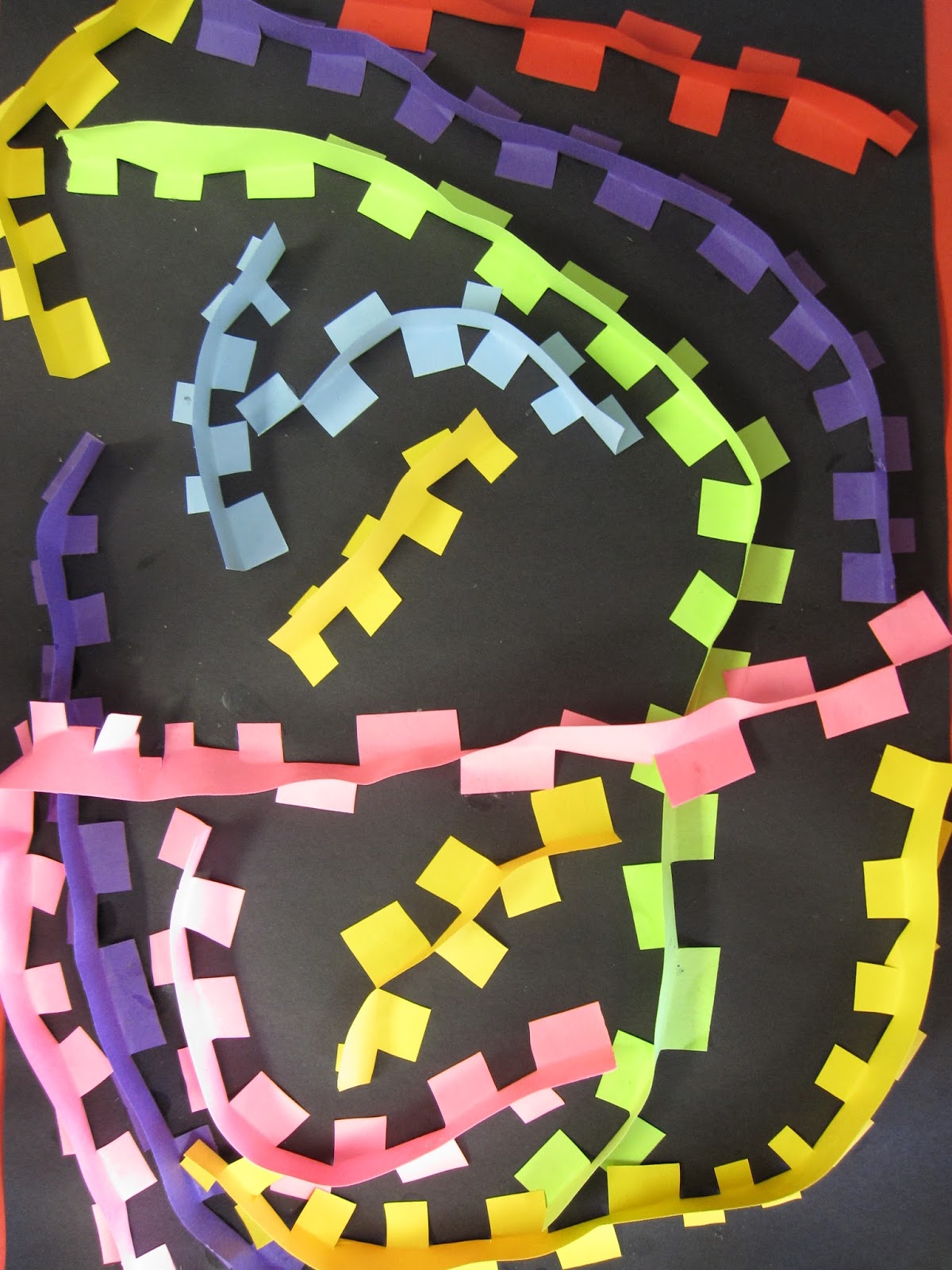
Rhythm Study
4th
Grade students discussed the meaning of rhythm in artwork and compared it to
rhythm in music. Students learned that rhythm can be shown in artwork when the
artist repeats lines, colors or shapes. Students used strips of paper, cut into
patterns and arranged their composition (artwork) in a way that they thought
showed the rhythm of a particular song.
Subscribe to:
Posts (Atom)